
By Britt Larson, Functional Health, IFBB PRO. February 24, 2025.
Let’s be real, if you’ve ever tried to make sense of the world of nutrition, fat loss, muscle gain, or bodybuilding, you’ve probably felt like you needed a detective’s badge. And an abyss to scream into. The internet is a battlefield of conflicting advice, flashy transformations, and marketing ploys disguised as “science.”
And let’s be honest – extremes get attention. The bigger the claim, the more clicks it gets. The more shocking the before-and-after, the more it sells. And whether it’s good or bad attention, attention = money.
But here’s what most people don’t realize: that health coach you follow? He might have every client on weight loss injections while he gets a monetary kickback (which, by the way, studies are now showing those injections can cause blindness. Yikes). That girl selling a booty-building program? She might have bought hers. That “natural” bodybuilder? Yeah, he’s using site injections to make his biceps pop. Not everyone, but MOST.
And the worst part? They aren’t telling you the full story.
People genuinely want to do the right thing when it comes to their health, but the waters are murky. With so many influencers, brands, and programs focused solely on selling you something—anything—they will do and say whatever it takes to get your money. Even if it means lying.

The Manipulation Game: How Marketing Works Against You
Companies are smart. They know how to connect with you – usually through a pain point. Want to lose weight? Gain muscle? Clear your skin? Sleep better? There’s a product for that! (And another product to fix the side effects of the first one.)
Marketing isn’t just throwing out ads and hoping for the best. It’s calculated. It’s researched. It’s designed to make you feel like you NEED something, even when you don’t.
A “Healthy” Product That’s Actually…Not
Let’s talk about one of the biggest “health” scams in the game: granola bars.
Sounds harmless, right? Healthy, crunchy, some fiber, a little nutty. You probably imagine Nicholas Cage in that scene where the wind is blowing in his face. Magical, yeah? Granola bars scream “I make good choices!”
Except, sigh, most are just glorified candy bars with a sprinkle of oats to make you feel better about eating them. They’re loaded with sugar, processed oils, and preservatives – but they market themselves as “organic,” “gluten-free,” or “high protein” to make you think they’re healthy.
It’s the same trick with “fat-free” products (hello, sugar overload) or “all-natural” labels (which legally means nothing).

How to Tell What’s Real and What’s BS
So, how do you separate the truth from the marketing? How do you know if someone is giving legit advice or just trying to sell you something?
Here’s your discernment guide – aka how to sniff out the BS and make informed choices:
1. Always Ask: Who Profits?
Before you buy into any claim, ask yourself: ➡️ Who is making money from this? ➡️ What’s their motivation?
Now, don’t get me wrong. There’s a difference between using herbs, vitamins, or supplements to support your health while making lifestyle changes versus someone popping into your inbox with the latest and greatest pill that requires zero effort on your part.
If someone tells you, “You don’t have to change a thing! Just take this magic supplement, and all your problems will be solved!” 🚩 Red flag, brother. 🚩
(And I say this with love because I was once in an MLM. I genuinely thought I was doing the right thing. I fell for the big promises—life-changing products, right? No. Just more expensive, a huge commitment, and honestly, predatory. They teach you to target people’s pain points on purpose. You truly believe that you are HELPING. In reality, it’s for a sell. And the wildest part? You can get the same stuff elsewhere for a fraction of the price, without paying a monthly fee just to stay “active.” Crazy. And that’s exactly why I see it so clearly now.)
2. Look for the “Fine Print”
If someone is promoting their “client transformations” or their own, seemingly always huge giant changes? Check for inconsistencies. Did they always look like that? Did they previously get surgery and now conveniently forget to mention it? Looking at you Miss Lipo while claiming it’s better gut health as you shill your gut-health program using your fake results and word salad as the bait.

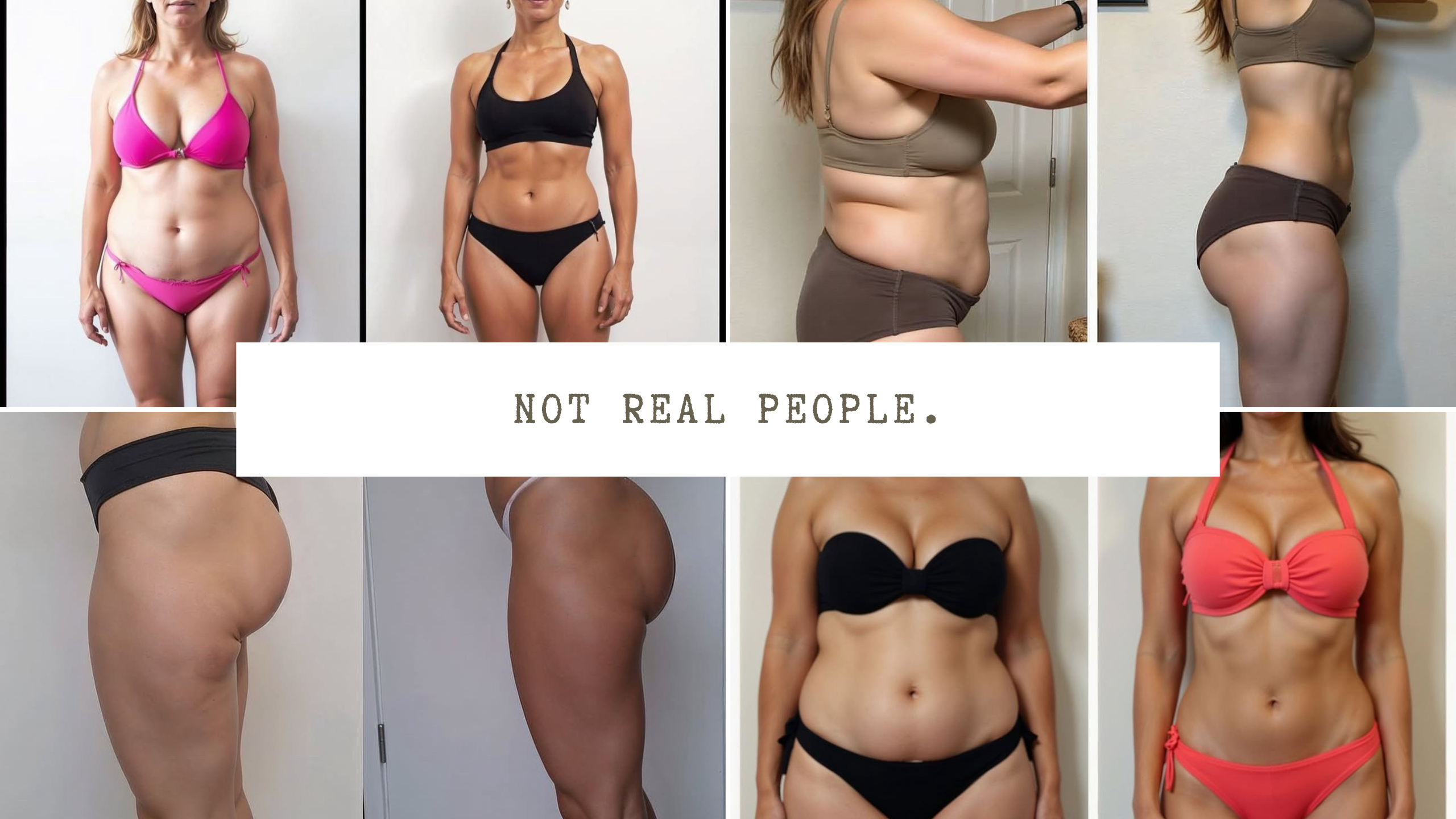
And here’s a new level of deception that most people aren’t even aware of: AI-generated transformation photos.
Yep. Some coaches are literally posting fake “before-and-afters” of people who don’t even exist. AI can now generate ultra-realistic images, and if you don’t have an eye for it, you’d never know. But take a closer look at the hands, ears, or background. Weird distortions? Probably fake.
We’ve officially hit a new level of insanity. That movie Idiocracy? We’re IN IT.

How to Spot AI-Generated “Before & After” Images
With AI advancing so quickly, some fitness coaches are now posting completely fake “before-and-after” transformations. The people in the photos? They don’t even exist.
How to spot an AI-generated fitness transformation:
- Check for distortions – Look closely at hands, ears, and facial features. AI often struggles with symmetry and fine details.
- Weird backgrounds – Warped door frames, uneven lighting, or backgrounds that don’t match between images are red flags.
- Too perfect? – If the transformation looks flawless with no signs of natural skin changes (like stretch marks or gradual muscle growth), be suspicious.
- Reverse image search – If something seems off, run the image through a reverse search to see if it appears elsewhere in an AI database.
The takeaway? If it looks too good to be true, it probably is. Don’t fall for AI-generated “proof” of a program that promises overnight success. The least they could do is add a blemish or two on that perfect skin. 🙂
3. Beware of Extreme Claims
🚩 “Lose 30 lbs in 30 days!”
🚩 “This ONE trick burns fat overnight!”
🚩 “No diet, no exercise—just take this supplement!”
No. Just no.
It’s never just ONE thing. It’s a combination of good practices:
✔️ Eating real food
✔️ Resting and managing stress
✔️ Moving your body consistently
✔️ Not relying on shortcuts that will wreck your health later
This is why I have big issues with how conventional medicine often skips over lifestyle habits and jumps straight to handing out pills like candy, yet calls Functional health pseudoscience.. But that’s a conversation for another day.

4. Do Your Own Research
Not all studies are created equal. Many are funded by the very companies trying to sell you something.
And I get it—research needs funding, much of this funding continues to get cut. So companies will fund studies on their own products. But here’s the catch: when the people paying for the research also benefit from the results, the data can be “adjusted” to highlight the positives and downplay the negatives.
That’s not to say all company-funded research is fake, but always look at who is backing the study and whether independent research supports the same conclusions.
5. Check the Ingredients (Not Just the Front Label)
The front of a package is a marketing tool. The back should tell the truth… but even then, food companies have wiggle room.
Legally, they can be up to 20% off when listing things like calories, carbs, and fats. So even if it says “zero sugar,” there might be just enough to keep it under the legal reporting threshold. Spray butter? Tictacs? Walden’s Farms Pancake Syrup? I’ve ruined a bodybuilding prep with these back in the day.
And speaking of sugar, here are some of the worst ones to watch out for:
❌ High fructose corn syrup (one of the worst for metabolic health)
❌ Aspartame and sucralose (linked to gut issues and insulin response)
❌ Acesulfame K (often used in “diet” foods, but linked to potential cancer risks)
❌ Agave nectar (sold as “natural,” but it’s crazy high in fructose)
Moral of the story? Read the full ingredient list, not just the front of the package.

How Can You Actually Make Good Choices? (The Solution Part!)
We’ve gone over much of the deception, scams, and the outright lies – but let’s talk about what you CAN do to make smart, healthy choices. Because the goal here isn’t just to avoid bad stuff, it’s to build a lifestyle that actually supports your health, fitness, and longevity in a way that’s realistic, sustainable, and works for YOU.
1. Flip the Script: Instead of “What Should I Avoid?” Ask, “What’s the Best Choice?”
It’s easy to get caught up and frustrated in the “don’t eat this, don’t take that” cycle, that can leave you feeling lost. Instead, focus on finding better alternatives rather than just eliminating things.
Swap This for That:
❌ Granola bars → ✅ Homemade energy balls with nuts, seeds, and raw honey
❌ Sugary “protein” shakes → ✅ A clean protein source like grass-fed whey isolate, low-temp processed isolate, or plant-based protein
❌ Fat-free, sugar-free snacks (usually loaded with artificial junk) → ✅ Whole foods with real, healthy fats like avocados, nuts, and full-fat greek yogurt (if you need an extra protein boost, add in a scoop of protein to mix in)
❌ Highly processed frozen meals → ✅ Batch-cooked, homemade meals with simple ingredients
❌ Sugary cereals labeled “high fiber” → ✅ Overnight oats or eggs with veggies
General rule: If it has a mile-long ingredient list with things you can’t pronounce, it’s probably not your best choice.

2. Read Labels (The Right Way)
We’ve already talked about how food labels can be misleading (since companies can be up to 20% off on their calorie and macronutrient listings – yep, twenty percent).
That means if something says it has 200 calories, it could really be anywhere from 160 to 240 calories, possibly more. Not to mention, food companies can legally round down to zero if an ingredient is present in small enough amounts, meaning “zero sugar” doesn’t always mean zero. That spray butter I mentioned? Threw it across the room into the garbage.
What to Look For on Labels:
✅ Whole, real ingredients (If you don’t recognize an ingredient, your body probably won’t either. Added vitamins and minerals often appear under long, scientific names like pyridoxine hydrochloride for vitamin B6 or cyanocobalamin for vitamin B12, so don’t confuse them with artificial additives.)
✅ Minimal added sugars (avoid hidden ones like dextrose, maltose, fructose, agave syrup, and cane juice)
✅ Healthy fats (olive oil, avocado oil, coconut oil, ghee—but NOT hydrogenated or refined oils like soybean oil, canola oil, vegetable oil, sunflower oil, safflower oil, or palm oil, which are often highly processed and inflammatory).
✅ A short ingredient list (5-10 simple, whole-food ingredients is a good target)
Pro Tip: The first few ingredients make up most of the product. If sugar or processed oils are at the top, put it back.
3. Focus on Real Food First
Supplements and products can support your health, but they shouldn’t replace real food. If your diet is based on shakes, bars, and pills, something’s off.
Build Your Plate with This Formula:
🍗 Protein: Grass-fed beef, wild-caught fish, free-range poultry, eggs, tofu, lentils
🥦 Veggies: Leafy greens, cruciferous veggies, colorful peppers, zucchini, mushrooms
🥑 Healthy Fats: Avocados, nuts, seeds, olive oil, coconut oil, ghee
🍠 Smart Carbs: Sweet potatoes, quinoa, legumes, wild rice, oats
🫐 Real Snacks: Berries, homemade trail mix, nut butter, high-quality dark chocolate
4. Train Your Eye for BS Marketing
Once you know what to look for, you start spotting scams from a mile away. Here’s a quick checklist to help you dodge the nonsense:
🚩 Buzzwords that don’t mean much (like “superfood,” “immune-boosting,” or “natural”)
🚩 Exaggerated claims (“Melt fat overnight!” “Gain 20 lbs of muscle FAST!”)
🚩 Overuse of celebrity endorsements (If they need a famous face to sell it, it’s probably not that great. ESPECIALLY if a Kardashian is in the mix. Yikes.)
🚩 Overcomplicated products (Good health isn’t found in a mystery shake with 50 ingredients.)
5. Balance Over Perfection
Here’s the deal: you don’t have to be perfect. Health isn’t about restriction, obsession, or chasing some “ideal” body, it’s about finding a way of eating and living that makes you feel good, strong, and energized.
Some days you’ll eat clean. Some days you’ll have pizza. Both are okay. The key is what you do most of the time.
If you’re focusing on:
✔️ Whole, nutrient-dense foods
✔️ Moving your body regularly
✔️ Managing stress and sleeping well
✔️ Minimizing processed junk without obsessing
Then you’re already miles ahead of the people chasing the next fad diet.
You Deserve the Truth
At the end of the day, your health is YOURS to protect. The fitness and nutrition world is filled with smoke and mirrors, but when you start asking the right questions, you’ll see through the BS. Your health is not a product to be sold. It’s something you build with real food, real habits, and real effort.
Next time someone tries to convince you that you need their life-changing supplement, their overnight success program, or some magic shortcut, pause and ask yourself:
❓ Is this actually beneficial? Or is it just clever marketing?
❓ Is this a quick fix or a real, sustainable change?
❓ Would this still work if I didn’t buy into it?
At the end of the day, you are in control of your health. Stay sharp, make informed choices, and don’t let the marketing machine trick you into thinking you need them more than you need real, simple, time-tested habits.
Stay smart. Stay discerning. And most importantly, take care of yourself—not just the version of you they want to sell to. You’ve got this.
If you’re looking for real guidance, my coaching is all about helping you navigate nutrition, fitness, and wellness in a way that actually works for you.
And if you’re in need of high-quality supplements, I’ve got two trusted sources I personally use and recommend:
- Titan Nutrition – Focused on fitness and wellness supplements (20% off here: [Titan Nutrition])
- Pure Encapsulations – Holistic, medical-grade supplements (Register here for 20% off with my practitioner code: 972244 [Pure Encapsulations])
No gimmicks, no unnecessary upsells—just solid products I trust. If you’re interested in working with me, learning more, or simply need guidance, you can check out my website here: [Limitless Health & Performance].
As always, thank you for spending some time with me today. Take care!
Britt Larson
@coachmusclenugget @limitlesshealthandperformance

disclaimer
This article is for informational purposes only and not a substitute for professional medical, nutritional, or fitness advice. Always consult a qualified professional before making health-related decisions.